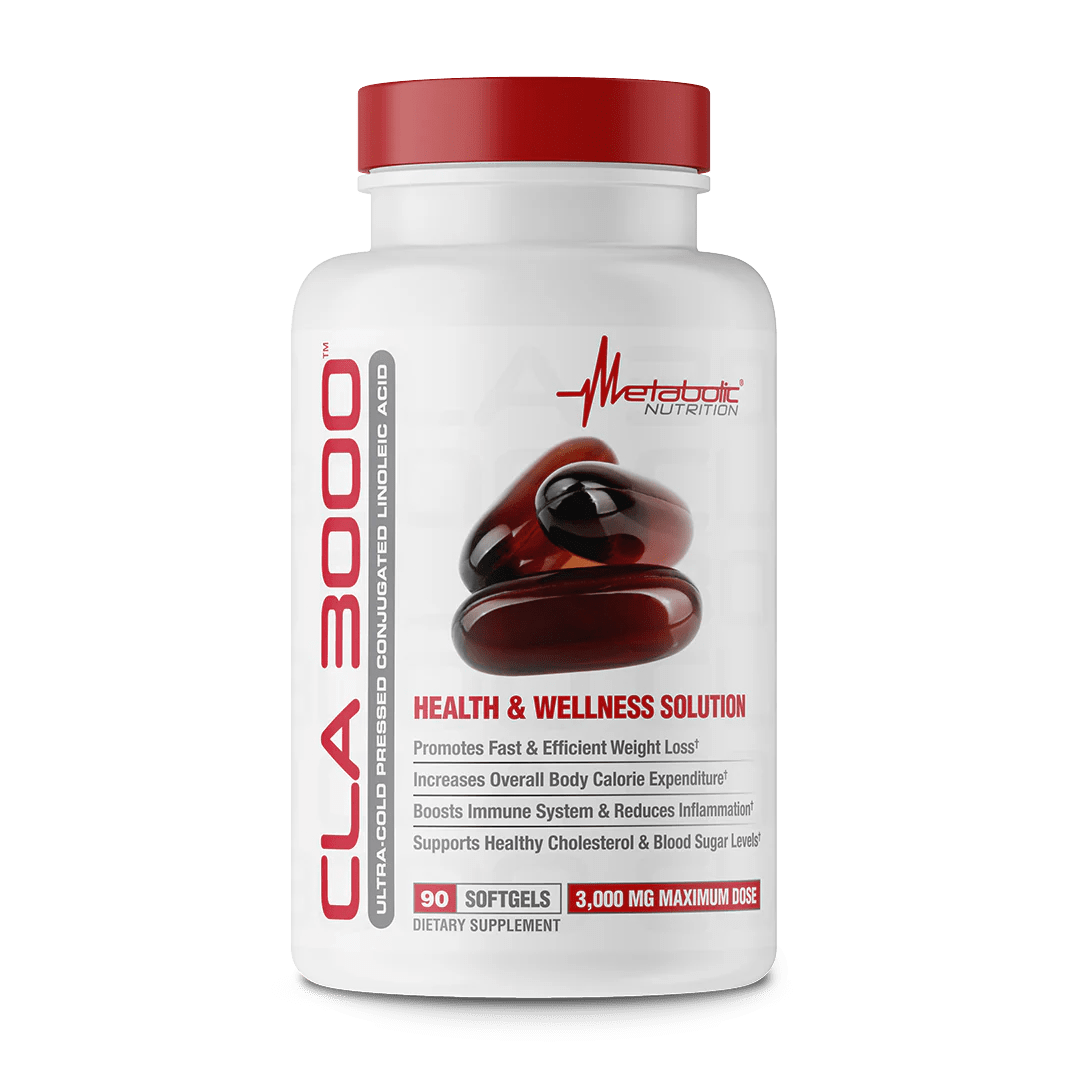
Metabolic Nutrition CLA 3000 is an ultra cold-pressed Conjugated Linoleic Acid supplement delivering 3,000mg of pure Safflower Oil CLA per three-softgel serving — 1,000mg per softgel. Vegetarian-sourced from Safflower Oil (not from dairy or beef), making it appropriate across a wider range of dietary preferences than animal-derived CLA supplements. Zero fillers, zero binders, zero preservatives, zero artificial ingredients — just CLA Safflower Oil in a softgel shell of Gelatin, Glycerin, Water, and Caramel Color. 90 softgels per container — 30 three-softgel servings. Also available in 180 softgels (60 servings). Take 3 softgels daily with food. Do not exceed 6 softgels per day. Contains Gelatin — not suitable for strict vegans. Produced in a facility that also processes common allergens — confirm on label.†
Supplement Facts — Metabolic Nutrition CLA 3000 (Per 3 Softgels / 30 Servings)
-
Conjugated Linoleic Acid (CLA from Safflower Oil) — 3,000mg (1,000mg per softgel)
- Other Ingredients: Gelatin, Glycerin, Water, Caramel Color
- Does NOT contain: Gluten, Dairy, Egg, Peanut, Fish, Soy, Shellfish, Wheat, Yeast, Fillers, Binders, Preservatives, or Artificial Ingredients
- Produced in a facility that processes ingredients containing these allergens
- Vegetarian-sourced CLA from Safflower Oil — not from dairy or beef
- Ultra cold-pressed — un-denatured CLA profile preserved
- 90 softgels per container — 30 servings
- Also available in 180 softgels (60 servings)
- Take 3 softgels daily with food. Do not exceed 6 softgels per day.
- Contains Gelatin — not suitable for strict vegans
What CLA Is and Why Safflower Oil Is the Standard Source
Conjugated Linoleic Acid (CLA) is a naturally occurring fatty acid found predominantly in the fat of ruminant animals — primarily dairy products and beef. It is a positional and geometric isomer of linoleic acid (omega-6), distinguished by conjugated double bonds at specific positions on its carbon chain. This structural difference gives CLA completely different biological properties from standard linoleic acid — including documented effects on fat cell metabolism, body composition, immune function, and inflammatory regulation that standard omega-6 fatty acids don't share.†
Most commercial CLA supplements — including Metabolic Nutrition CLA 3000 — are produced from Safflower Oil (Carthamus tinctorius), not from animal sources. Safflower oil naturally contains high concentrations of linoleic acid, which is converted to CLA through a controlled bacterial biohydrogenation process that produces a concentrated CLA extract. The resulting Safflower-derived CLA is chemically identical to the CLA found in dairy and beef fat, making Safflower oil the industry standard source for CLA supplementation. The vegetarian sourcing makes CLA 3000 appropriate for users who avoid animal-derived supplements while still requiring the active CLA isomers for their documented body composition effects.†
How CLA Supports Body Composition — The Mechanism
Fat Cell Biology and Adipocyte Regulation
CLA's primary body composition effects operate at the level of fat cell biology rather than through the thermogenic or stimulant mechanisms that most fat burners use. CLA has been shown in research to reduce the activity of lipoprotein lipase (LPL) in adipose tissue — the enzyme responsible for facilitating the uptake and storage of triglycerides from circulating lipoproteins into fat cells. By reducing LPL activity, CLA reduces the rate at which circulating dietary fat is stored in adipose tissue. Simultaneously, CLA promotes apoptosis (programmed cell death) in mature adipocytes over time, reducing the total number of fat cells available for fat storage. The combination — reduced new fat storage and reduced fat cell population — is the mechanistic basis for CLA's documented body composition effects.†
PPARα Activation and Fat Oxidation
CLA, particularly the cis-9, trans-11 isomer, activates PPARα (Peroxisome Proliferator-Activated Receptor alpha) — a nuclear receptor transcription factor that controls the expression of genes governing fatty acid beta-oxidation. When PPARα is activated, it upregulates the transcription of enzymes involved in fatty acid transport into mitochondria (carnitine palmitoyltransferase I) and the beta-oxidation pathway itself, increasing the rate at which the body oxidizes fat for energy. This gene-expression-level effect on fat metabolism is a slower, more foundational mechanism than acute thermogenesis — CLA's body composition benefits develop progressively over weeks to months of consistent supplementation rather than producing acute changes after a single dose.†
Lean Muscle Preservation
One of CLA's most practically significant documented effects is lean mass maintenance during caloric restriction. Multiple clinical trials have demonstrated that CLA users maintain or increase lean body mass during periods of caloric deficit — the body composition improvement is simultaneous fat reduction and muscle preservation rather than the non-selective weight loss that produces both fat and muscle loss during diet alone. This anti-catabolic effect on lean tissue makes CLA particularly relevant during cutting phases where maintaining hard-earned muscle while reducing body fat is the primary goal. Research suggests CLA's mechanism for lean mass preservation involves its effects on muscle protein synthesis signaling and its anti-catabolic properties on skeletal muscle tissue.†
Metabolic and Immune Health Support
Beyond body composition, CLA has documented effects on several metabolic health markers. Research citations in Metabolic Nutrition's own product documentation specifically reference a published study (Asp et al.) on safflower oil's effects on glycemia, inflammation, and blood lipids in obese postmenopausal women. The broader CLA literature documents improvements in insulin sensitivity, support for healthy cholesterol levels (particularly improvements in the LDL/HDL ratio), and anti-inflammatory activity through modification of arachidonic acid metabolism — reducing the production of pro-inflammatory eicosanoids that drive systemic inflammation.†
The CLA Isomer Question — What Safflower-Derived CLA Provides
CLA is not a single compound — it is a family of structurally related fatty acid isomers that differ in the position and geometry of their conjugated double bonds. The two most commercially significant isomers are cis-9, trans-11 CLA (c9,t11 — the dominant isomer in ruminant animal fat, comprising 75–90% of naturally occurring CLA in dairy) and trans-10, cis-12 CLA (t10,c12 — a secondary isomer in nature but present in higher proportions in commercially produced safflower-derived CLA). Standard safflower oil bacterial biohydrogenation produces approximately equal proportions of c9,t11 and t10,c12 CLA — a roughly 50/50 mixed isomer profile.†
Both isomers have documented research behind them. The c9,t11 isomer is the form most associated with immune function support and anti-inflammatory properties. The t10,c12 isomer is the form most associated with the fat cell biology effects (LPL inhibition, adipocyte apoptosis, and body composition changes) documented in body composition research — some studies specifically attribute the fat loss and lean mass effects primarily to the t10,c12 isomer. Metabolic Nutrition's CLA 3000 uses standard Safflower Oil CLA, providing the mixed isomer profile at 3,000mg per serving — the dose at or above the threshold used in most positive clinical research outcomes.†
Ultra Cold-Pressed — Preserving CLA Bioactivity
The "ultra cold-pressed" designation on CLA 3000 addresses a legitimate quality concern for CLA supplements. CLA's conjugated double bonds — the structural feature responsible for its biological activity — are sensitive to heat-induced isomerization and oxidation. Heat-processed or solvent-extracted safflower CLA can undergo structural changes that reduce the proportion of biologically active isomers and introduce oxidized fatty acid byproducts. Ultra cold-pressed processing extracts the CLA-rich safflower oil at minimal temperatures, preserving the native isomer ratios and preventing the lipid oxidation that reduces bioactivity. Metabolic Nutrition's commitment to ultra cold-pressed processing parallels their approach across the CLA 3000, OMEGA 369, and MCT 3000 product lines — the same quality standard applied consistently.†
CLA 3000 vs. Global Formulas bioLEAN — How They Compare
Both products are CLA-based body composition supplements, and both are available at Get Yok'd. The key difference is specificity. Global Formulas bioLEAN is positioned as a CLA Isolate standardized specifically for the cis-9, trans-11 isomers — a targeted approach to the naturally occurring CLA isomer with the most human research. Metabolic Nutrition CLA 3000 uses standard Safflower Oil CLA providing a mixed isomer profile (approximately 50/50 c9,t11 and t10,c12). Both products deliver 3,000mg of CLA per three-softgel serving — the dosing is equivalent. CLA 3000's advantage is the clean, no-additive formulation, the vegetarian sourcing, and the accessible price point. bioLEAN's advantage is the isomer specificity. For most users the practical difference between the two approaches at equivalent doses is modest — consistent daily use at 3g per day produces meaningful results from either formula.†
Frequently Asked Questions
-
How long does CLA 3000 take to produce noticeable results?
CLA operates through gene expression-level fat cell biology mechanisms — not acute thermogenic stimulation. Results develop progressively over weeks to months of consistent supplementation. Most users report noticeable changes in body composition (reduced waist measurements, improved muscle definition) at 4–8 weeks of daily use alongside a caloric deficit and regular training. The lean muscle preservation effect is often noticed before the fat loss effect — the scale may not move dramatically while measurements improve.†
-
Is CLA 3000 appropriate for vegetarians?
The active ingredient — Safflower Oil CLA — is vegetarian. However, the softgel shell contains Gelatin, which is an animal-derived ingredient. CLA 3000 is therefore not suitable for strict vegans or vegetarians who avoid gelatin. Individuals who avoid animal products only in their diet but not in supplement capsule shells may find the formulation acceptable for their purposes.†
-
Can CLA 3000 be stacked with other fat loss supplements?
Yes — CLA's mechanisms (fat cell biology, PPARα activation, lean mass preservation) are entirely distinct from thermogenic stimulants, carnitine-based fat transport, and hormone-based fat mobilization. CLA 3000 stacks cleanly with Metabolic Nutrition L-Carnitine 3500, thermogenic fat burners, pre-workouts, and any other supplement without interaction. Taking CLA alongside a stimulant fat burner (which mobilizes fatty acids) and carnitine (which transports them into mitochondria) creates complementary coverage of three distinct fat loss mechanisms simultaneously.†
-
Why does CLA 3000 need to be taken with food?
CLA is a fat-soluble compound whose absorption is significantly enhanced by the presence of dietary fat in the GI tract at the time of ingestion. Taking CLA with a meal that contains some fat stimulates the formation of lipid micelles — the fat-digestion structures that incorporate fat-soluble compounds for absorption through the intestinal wall. Taking on an empty stomach reduces absorption efficiency and may cause GI discomfort in sensitive individuals.†
How to Take Metabolic Nutrition CLA 3000
Take 3 softgels once daily with food. Do not exceed 6 softgels per day. Taking with a meal containing some dietary fat maximizes CLA absorption. For best results, use consistently every day including non-training days — CLA's fat cell biology mechanisms operate continuously and benefit from uninterrupted daily supplementation. Store in a cool, dry place away from direct sunlight and excess heat. Not intended for pregnant or nursing mothers. Not intended for children under 18 years of age. Consult a physician before use if taking any medications or having any medical condition. Contains Gelatin. Produced in a facility that processes Gluten, Dairy, Egg, Peanut, Fish, Soy, Shellfish, Wheat, and Yeast.†
Why Buy at Get Yok'd
- Real-time inventory across all five Southern California stores
- Available in Burbank, Glendale, Glendale Galleria, Pasadena, and North Hollywood
- Authorized Metabolic Nutrition retailer — carrying the full lineup including CLA 3000, OMEGA 369, L-Carnitine 3500, and MCT 3000
- Staff who can help you build a complete non-stimulant fat loss stack in person
- One of the best loyalty programs in the supplement industry — earn rewards on every purchase
Who Should Exercise Caution with CLA 3000
- Not intended for pregnant or nursing mothers
- Not intended for children under 18
- Individuals with insulin resistance or Type 2 diabetes should consult a physician — some research on the t10,c12 CLA isomer documents effects on insulin sensitivity that may be relevant in diabetic contexts
- Individuals with cardiovascular conditions or lipid disorders should consult a physician before long-term CLA use
- Not suitable for strict vegans — contains Gelatin capsule shell
- Produced in a facility that processes common allergens including Gluten, Dairy, Egg, Peanut, Fish, Soy, Shellfish, Wheat, and Yeast
- Consult a physician before use if taking any prescription medications
- Keep out of reach of children and pets.
†These statements have not been evaluated by the Food and Drug Administration. This product is not intended to diagnose, treat, cure, or prevent any disease.